Sunday, January 4, 2015

Some general Read-A-Thon goals

The start of the Bout of Books 12 Read-a-thon is about 90 minutes away, so I thought I would put down some general goals for the week.

  1. I'd like to read, on average, about 100 pages per day,or 700 pages for the week;
  2. I'd like to finish at least one book during that time, though getting deep into a couple of books would be a good outcome as well.
I've got a list of some books that I plan to read throughout the week, though I'm certain that on Wednesday morning, for example, I'll pull something off the shelf at random and read it for the rest of the day:
  • The second volume of Joseph Frank's biography of Dostoyevsy;
  • Palace Walk, the first novel in Naguib Mahfouz's Cairo Trilogy;
  • John A. Williams' Appalachia:  A History;
  • Peter Carey's novel Parrot and Olivier in America;
  • Niccolo Rising, the first novel in Dorothy Dunnett's House of Niccolo series.
I'll post updates as the week progresses.

Saturday, January 3, 2015

Getting back into it

I've let this blog go for a couple of months, but I'm back. 

To get back in the groove, I've signed up for the "Bout of Books Read-a-thon," which starts on Sunday night at midnight (12:01 am Monday, technically) and ends Sunday night, January 11.  If you're interested, here's the link:

http://boutofbooks.blogspot.com/2014/12/bout-of-books-12-sign-up.html

I plan to post updates throughout the week.  I'll also put up a list of some possible books to read by Sunday evening, so check back!

Thursday, September 4, 2014

Start of the academic year

No matter what I try to do, or what I promise myself, the start of the fall semester always winds up consuming way more of my time than I want or expect--thus, no posts for a little while.

I've got a couple of books that I'm close to finishing, including Howard Jacobsen's new novel J., which is on the Booker longlist.  I hope to finish that in the next couple of days and post my comments on it over the weekend. 

Almost done with week two of the semester, so things are starting to settle down and a rhythm is developing for each course.  Here's to returning to this blog!

Wednesday, August 27, 2014

Julie Schumacher, Dear Committee Members

Let me start off by saying that I gave this novel 5 stars.  The novel consists entirely of letters written by Professor Jay Fitger about the quirks of faculty and university life, as well as the complicated matter of writing letters of recommendations for every student who asks.  He writes to the dean, the associate dean, the department chair, scholarships and awards committees, his literary agent, the director of a writers' retreat, and both his ex-wife and his former girlfriend.  He also writes letters of recommendation for students pursuing graduate studies or trying to get jobs.  He writes for his excellent students, and for students who have failed his course.  It's clear that he is fed up with having to write all of these emails, memos, and letters.

The novel is a satire, and for those of us who work in colleges or universities, the letters, memos, and emails he writes are very familiar.  Most of us have written similar documents, or received them.  Schumacher satirizes these extremely well, evoking the form, structure, and voice of these kinds of documents, while simultaneously mocking them.  Each letter or memo in the novel has a consistent voice--as you move from one letter to the next, there is no question that Fitger is the author.


I don't know whether this novel would be successful with a reader who has not lived in the institutional culture of universities.  It seems to me that there are inside jokes and references which would go unnoticed, and I can't decide whether or not the novel would seem tedious to non-academics.  Many of the letters are, however, very funny even if you haven't ever written a letter of recommendation.  It's a hilarious novel, and I hope that humor is evident to all its readers.

Tuesday, August 19, 2014

Dorothy Dunnett, Game of Kings

In her 1919 poem ""In the Days of Prismatic Color," Marianne Moore wrote

complexity is not a crime but carry
it to the point of murki- 
ness and nothing is plain.

Moore's poetry is complex and difficult, but I enjoy the challenge of her poetry.  She successfully walks the fine line between complexity and impenetrability.  One has to work at reading Moore's poems, but the effort yields tremendous rewards.

The Game of Kings by Dorothy DunnettDorothy Dunnett's writing is also complex and requires attention.  I had never heard of Dunnett's work until a couple of weeks ago (now I wonder how that's possible), and then in the course of a couple of days, I found several reviews and references to her six-novel series, The Legendary Lymond Chronicles.  While many reviewers praised the Game of Kings, the first in the series, several panned them, saying that they were too complicated or confusing. Some readers said that they were completely lost in the first hundred pages; others that they could not figure out who all the characters were, and why they were relevant.  The novel, for these reviewers, was complex beyond the point of murkiness, and wasn't worth the effort.

I wondered, as I read the negative reviews, what the Goodreads or Amazon reader reviews would be for William Faulkner's novel, The Sound and the Fury.  How would readers handle the challenge of reading the opening Benji section and not knowing a) that it is told by a mentally challenged man, and b) that the narrative in Benji's section switches time periods often and doesn't give the reader any explicit indications of what year Benji describes.  You have to read through the whole novel and then go back to that section to make sense of the stories Benji is telling.  My guess is that The Sound and the Fury would probably rate somewhere in the lower 3.0 range on reviews, with lots of one-star reviews saying things like "don't waste your money, this is an incomprehensible pile of garbage."  And that about a novel with one of the most brilliantly-conceived narrative structures in the history of the novel. 

So back to Dunnett.  I confess I was drawn to Game of Kings by the claim that the novel was impenetrable.  I wanted to take up the challenge and see whether the ecstatic fans or the detractors were right.  I vowed I would read through the first 150 pages without trying to sort out all the characters and plotlines, and decide then whether to continue reading. What I discovered was that I was hooked by page 50, not because I had figured out who everyone was, or what exactly was going on, but because Dunnett's writing was so compelling.  I wanted to keep reading the sentences she wrote.  Over time, I would figure out what was going on. 

Take, for example, this pair of sentences describing an archery competition:  "The wind, violent and skittish, was making better sport of it than the competitors were.  Buccleuch, shooting third, nicked the post with his first shaft and overshot with his second, retiring bellowing amid a chorus of witticisms" (145).  These two sentences tell us a lot in short order:  the wind is a significant factor, and one that is inconsistent in its effect on the arrows (it's skittish, not sustained); the first two shooters fared poorly because of the gusting wind; Buccleuch misses low and high with his two shots; he is angry because he missed; and the crowd mocks him because of his misses.  To me, that's an extraordinarily economical way to describe a fairly involved scene.  And they are interesting sentences as well, because of the vibrant language (skittish, nicked, overshot, bellowing) and the arrangement of the elements.  I love the fact that Dunnett, in twenty-two words, can show us Buccleuch's turn, from the first arrow to the response of the crowd when he's done. 

But I wonder if Dunnett's economy of words creates a challenge for readers who are used to things laid out at length.  You can't speed-read through those sentences and have a clear sense of what's going on.  You have to attend carefully to each clause; you can't skim.  If you don't read attentively, then you're likely not to follow what's happening.  Henry James wanted readers who would read attentively, and if you've read his late work, you know that you have to read carefully to sort out the syntax.  I think Dunnett wants that kind of reader as well. 

Having said all that, I thought Game of Kings was an excellent novel.  Its complexity is a strength, not a weakness.  When I finished it, I immediately searched the library catalogs in the region to find out where I could get the next two in the series.  To my dismay, I discovered that they are not held at any local libraries, so I plan to buy the whole series.  If the later books are as good as the first, then having them all on hand to re-read over the years will be well worth the investment.

Wednesday, August 13, 2014

John LeCarre, Smiley's People

Smiley's People by John le CarrĂ©Smiley's People is the final novel in the Karla trilogy, and the sixth book I've read by John LeCarre.  The first novel, Tinker, Tailor, Soldier, Spy was excellent; the second, The Honourable Schoolboy, I thought was a pretty tough slog, though it's possible that I was reading it at a bad time.  I think Smiley's People is the best of the trilogy, and the best of the other five I've read.  I've always been fascinated by Smiley, the academic and accomplished spy master.  He couldn't be more bland:  he's not a flashy Bond character at all.  He's a person who dresses like an academic, who often looks as though he might be dozing off during important meetings, who often says very little, and who appears to have very few pleasures in his life.  If you were to write a summary of his character and ask people whether they'd be interested, my hunch is that they would not. 

And yet, and yet . . . it is fascinating watching how all of his quirky behaviors turn out to be part of a carefully-planned, overarching strategy intended to make people think a certain way or say certain things.  I think this is part of the brilliance of Le Carre novels:  he has built a character based on slight movements and minimal communication, and shown how that character can succeed--and perhaps even more, that only that kind of person could succeed.  There are no theatrics, no fireworks when George Smiley talks.  We never quite know where it will all lead, or more importantly, how Smiley will get to his goal.  Like the people he talks to, we are often in the dark about what he is really asking, what he is really scrutinizing.  He's the anti-hero, or maybe better, he's the introverted hero.

One of Smiley's great qualities is his ability to stay calm and logical in the face of challenging, dangerous situations.  But Smiley is not perfect:  one of his apparent weaknesses is that there are moments when he hesitates to make big decisions.  Part of the joy I experience reading Le Carre's novels is seeing an extremely intelligent main character accomplish brilliant things while also being clearly flawed


Sunday, August 10, 2014

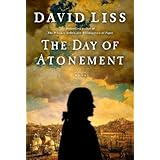
David Liss, Day of Atonement

Product DetailsDavid Liss's latest novel, Day of Atonement, brings us to Lisbon in 1755.  Sebastian Fox/Sebastiao Raposa, born in Lisbon, has lived in England for ten years and been trained by Benjamin Weaver, the ex-boxer/private investigator who features in several of Liss's earlier novels.  Sebastian has returned to Lisbon to get revenge on the priest who, as part of the Inquisition, caused him to lose everything and flee when he was a boy.  The novel chronicles Sebastian's efforts to build a network of business contacts that will enable him to accomplish his goals.  What he discovers over time is that what seemed like a simple task becomes an extremely complicated project.

This is a very good novel:  I felt throughout as though a master craftsman was unfolding a story at just the right pace, and in a manner that pulled me along.  Liss is not only an excellent writer, he's also a close observer:  he doesn't describe everything and every place in great detail, but he often provides a couple of subtle details that give a very specific quality to the scene.

One of the key elements of the novel is the development of Sebastian's self-awareness:  as the novel progress, Sebastian realizes that he often misjudges people.  Liss shows this through several different encounters Sebastian has, and we watch as the simple world that Sebastian has imagined crumbles and a much more difficult one emerges.  If Sebastian, at the beginning of the novel, is supremely confident in his ability to avenge his loss through his superior physical skills, by the end he knows that those skills, while important, cannot be used to sort out difficult moral problems.  The novel doesn't end with Sebastian having a miraculous epiphany and transforming himself completely.  He has realized that his self-confidence and belief in the rightness of his cause are naive and based on his immature, myopic view of the world.  It's not quite a coming-of-age novel, but Sebastian has matured significantly, and Liss does a fine job of showing us the process that leads to this outcome.

The plot of the novel is straightforward:  Liss does not introduce a large number of narrative threads that ultimately he needs to tie up at the end.  He does maintain, however, a level of complexity that requires the reader read attentively more than a page-turner would require.  I suspect that Liss will follow this novel with another about Sebastian London; I would be interested to see how a mature version of Sebastian would move through the world.