Showing posts with label 20th-century literature. Show all posts

Tuesday, June 24, 2014

Philip K. Dick's The Man in the High Castle


The Man in the High CastleI'm at the beach house, and I read almost all of The Man in the High Castle in a little over 24 hours.  One of the benefits of being on vacation at the beach is that there are not many obligations, beyond applying sunscreen evenly and eating too much.  So it was quite easy, and perfectly acceptable, to commit myself almost exclusively to reading the novel.

And it's a good thing I had that luxury, because I got to a certain point where I could not stop reading it.  I read a comment recently saying that Dick's genius was his ability to imagine worlds and reveal them in his novels, but that he was not a great writer.  As I read through The Man in the High Castle, I kept thinking how much I disagree with that assessment.  His brilliance is in the ideas that form the novels, but Dick also crafts compelling stories, and develops interesting characters.

This novel makes you think. The central premise is that the Germans and Japanese won World War II, and Dick offers a version of what the world they would have created might look like.  It's hard not to think about the implications of that premise the entire time you're reading the novel.  What would it mean if the United States had been split up in 1945, instead of Germany, and governed by different nations living in a tense, fragile peace?  What would happen to "Americanness" in that version of the world?  How long would it take for the "former" United States to lose that identity?  What would happen to the history of the United States?  Where and how would it be preserved, if at all?  And those kinds of questions inevitably lead to questions about the actual post-War world the Germans and the Japanese experienced in the 1950s and 60s.  Dick makes us think, in other words, about life as the conquered, not the victors, and it's an uncomfortable, disconcerting experience. 

Sunday, April 27, 2014

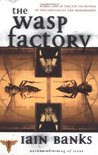
Iain Banks' The Wasp Factory

The Wasp Factory by Iain BanksI came to The Wasp Factory  by way of two of Iain Banks' Culture novels, Consider Phlebas and The Player of Games, so I assumed it would have a science fiction angle.  I never expected a novel filled with brutal, violent stories, and narrated by a chilling, cold, rational, and deeply disturbed character.  But as the novel unfolded, I was struck most by how good this novel is despite being unsettling.

The novel is impressive because of the powerful narrative voice. As I read, I kept thinking how strange it was to be drawn to the stories of such an apparently disturbed mind.  The sense of order and control are strong, and Frank, the narrator offers perfectly lucid explanations for what he does or has done in the past.  And yet, all along, there are also moments when I paused and thought about how wrong those explanations, and the events, are.

Somewhere in the middle of the novel, it becomes painfully obvious that the novel will end with some stunning revelation.  I was not able to anticipate the revelation, and was very surprised by the twist the narrative took.

The Wasp Factory is an excellent novel, but one that leaves one wondering whether it's wrong to like it so much.

Sunday, March 30, 2014

Graham Greene's Quiet American

I cruised through the first half of the novel, and then set it aside for a couple of weeks.  As I read the second half, I found it somewhat challenging to reconstruct what had happened earlier.  In some ways, I think my experience gets at a fundamental element of the novel:  there is Fowler's life with Phuong and without Pyle, and then there is his life with Pyle.  They are very different lives.

To put it bluntly, Pyle is a painfully obnoxious character.  Greene does a brilliant job of showing Pyle's earnestness and righteousness as offensive qualities.  Pyle is a New England Puritan who believes that Phuong should be treated a particular way.  That's to say that Pyle wants to Americanize her, and thereby raise her out of what he sees as her benighted state.  He thinks the Vietnamese are childlike, and his condescension is palpable.  But unlike other versions of American superiority in the novel, Pyle's is complicated by his apparent innocence.  What comes out clearly is that those who are innocent, righteous, and earnest are more dangerous than those who explicitly claim and try to impose their superiority.

Greene does an excellent job of making explicit the formula for imperialism:  the desires or deaths of indigenous people matter much less than the abstract good the colonizers think they bring.  To put it differently, Pyle and his kind think that losing a couple thousand Vietnamese as "collateral damage" is a cost worth taking if it leads to a Vietnamese society arranged on an American plan.  In The Quiet American, the names of the colonizers appear to be changing, but regardless of the names, the Vietnamese are still the colonized.

I think Greene does an excellent job of showing, in Pyle, the ability to compartmentalize one's experiences and beliefs.  Pyle imagines Phuong as the mother of his children, and earnestly desires her as a companion.  He lectures Fowler on appropriate relations between men and women.  And yet, Pyle has no compunction about being part of a plan that kills women and children.  These two things take up different parts of his brain, and he keeps them separate.  I think the novel shows that this kind of mental and emotional distinction is possible if one sees people as abstractions.  The Vietnamese are an abstraction, and Pyle does not care about them, only about the desired political outcome.  Phuong is a real person, and he sees her differently--but in the end, he sees her as an object to be raised up into a state of American "civilization."

Friday, March 7, 2014

Cather follow-up

Sure enough, first thing this morning in class I was reminded of what I posted last night about teaching books you love.  Right before we started, one of the students said "I don't know how reading My Antonia is ever going to help me in my life."  Ouch.  It led to a good conversation, but in that first moment, I thought that my decision to teach Cather had been a bad one.

Thursday, March 6, 2014

Willa Cather: Teaching what you love

I've had the pleasure this week of teaching Willa Cather's My Antonia again in my American Lit II survey.  It's one of my favorite novels, one that I find deeply moving, beautiful, and beautifully wrought.  I'm not sure how many times I've read it--4? 5? more?--but I always come back to it and marvel at the effect such lean prose can have on a reader.  I should also say that, each time I get ready to teach this book or Marianne Moore's poetry (my favorite poet), I am reminded of advice I was given by a professor in grad school:  never teach books or poems you absolutely love.  I have never actually heeded the advice, but I have had  many moments when I wish I had.

I think that professor meant that the beauty of the thing you love will likely not be appreciated by those who you are teaching.  You will insist on it and show evidence--"look at this evocative passage . . ."--but fail to get most of them to see what you see.  You bring the work to a group of people who cannot possibly love it the way you do.  Some may come to enjoy it after their first readings; others will think it boring; and worse, still others will not care at all.  A chasm opens between your strong feelings about the text and their indifference, and that frustrates and angers you.  Why expose such a beloved thing to such rejection?

In part, I do it to show students a work of art that I think is superior.  But more than that, I do it to show students that it is possible to be passionate about literature.  I make it clear to my students that I love My Antonia.  I know they won't immediately, if ever--in fact, if I assign a large chunk of the novel, they will dislike it because they will associate it with too much work.  But some of them do like it, and in the course of the class conversations, come to understand more clearly why they do.  And that makes it worth teaching it.

When I was teaching at Auburn, I had a football player in one of my courses who enjoyed literature, and what we read in my course in particular.  At the end of the semester, he invited me to the "Top Tiger" banquet, an event that celebrated the academic success of outstanding student-athletes.  During dinner, one of my English department colleagues asked him what book he enjoyed reading most in my course.  The student said Henry James's The American, another one of my favorites.  I was stunned.  I never expected to hear any student--EVER--say Henry James was a favorite.  But he went on to talk about why he liked it.  I came away from that experience convinced that I had to keep teaching books I love deeply as well as others that I just think are important.

And so I am teaching My Antonia; things have gone only ok this time.  I'm not sure my students are reading much of it right now.  Spring break is one day away, and the weather has depressed us all.  The conversation about the book sputters and flounders often.  And yet, I find myself experiencing the joy of re-reading the novel, and speaking passionately about it to my students. 

Sunday, March 2, 2014

Joseph Conrad's Under Western Eyes

During the summer before my junior year in high school, my English teacher Mr. Hull assigned us Joseph Conrad's Nostomo to read before the school year began.  I purchased the book in the middle of the summer, read enough to be miserable (I was only 15 at the time), and put Conrad behind me until last month.  I have NO excuse for having ignored Conrad for this long:  in the intervening time, I also finished a Ph.D. in 19th-century literature, and have taught literature in college for many years.  By this point, I should have read some Conrad.    

One of the things I value in the reading challenges I've discovered this year is the way they make me rethink my reading habits.  Thanks to the Classics Club challenge I discovered in January, I gave a lot of thought to the holes in my reading as I created my 5-year challenge list.  Joseph Conrad's Under Western Eyes wound up on the list.

I found Conrad's exploration of the complexity of right and wrong compelling.  The novel hinges, generally, on two acts:  Haldin assassinates a Russian official, and Razumov helps the police capture Haldin.  Both things take place in the first 100 pages of the novel, and that's basically the extent of the action in the novel.  What follows, however, is a story about how Razumov tries to escape his guilt, how his act is revealed, and the effects of both the guilt and the revelation on him.

The reader is tempted to see Haldin, the revolutionary, as the hero who has acted against the Russian empire, and to see Razumov as a traitor because he gave up Haldin.  But as the novel unfolds, it becomes difficult to hold these positions.  Haldin sacrifices his life to a revolutionary cause, but he has also committed murder.  By turning Haldin in, Razumov betrays the revolution but also rejects the idea that murder is consistent with a righteous cause.  And yet, Razumov also has a moment where he behaves violently towards a helpless man.  The revolutionaries Razumov meets in western Europe are not saints.  There is no absolutely good or bad person in this novel--only people who respond to discreet things in good or bad ways.

I'm actually glad that I waited until this point in my life to read Conrad again.  I'm not sure I would have enjoyed this prior to 2000, when my interests turned to Russian literature and history.  As I read Under Western Eyes, I kept hearing echoes of Dostoevsky and his obsessions, and that helped place Conrad in a useful context.

Sunday, February 9, 2014

Sigizmund Krzhizhanovsky's Autobiography of a Corpse

I wanted to love this book, really.  It's a collection of short stories written by a Kyiv-born author in the 1920s and 1930s, so the irrational side of me that wants to celebrate all things Ukrainian right now was prepared to drive this review.  Unfortunately, the uneven quality of the stories leads me to write a different kind of review than I had intended.

Krzhizhanovsky offers a number of interesting scenarios and ideas in the stories, but in several stories he doesn't develop them in a way that grabs the reader and keeps him or her interested.  The opening story "Autobiography of a Corpse" is a curious tale about a man who rents a small room and soon after receives a manuscript (left at his door anonymously) that is an autobiographical account of the life of the person who lived in the room before the current tenant.  The story works, primarily because Krzhizhanovsky creates an interesting tension between the tenant and the narrator of the autobiography.  Other stories in the collection don't work as well.  The premises of "The Runaway Fingers" (the hand of a concert pianist escapes from his arm and flees down the street) and "Yellow Coal" (a man discovers that anger can be turned into an alternative energy source) are intriguing, but not, in the end, compelling. 

Tuesday, February 4, 2014

Anatoli Rybakov's Fear


Fear is the second novel in the Anatoli Rybakov’s “Arbat” trilogy, and after reading more than 1,200 pages about these characters (Children of the Arbat is the first), I’m eager to read the third. 

What demonstrates Rybakov’s brilliance as a writer is the way he creates a story that moves along briskly, compelling the reader to push on, while simultaneously making us feel like the world is grinding to a halt for every character.  The reader feels trapped and suffocated while reading Fear.  At every turn, we feel the Soviet system blocking off another avenue that might have enabled a character to start leading a normal life.  We also come to feel, as we read, as if every conversation between every character is potentially the one that will lead to an arrest and ultimately either a prison sentence or death.      

Rybakov creates characters that we come to know well, and who we come to care about.  We want them to survive, to find a measure of freedom and relief from fear, and to have the luxury of imagining a long life.  But throughout, we know that can’t happen in the Soviet Union in the 1930s, and so part of the experience of reading the novel is trying to figure out not if, but for what, the characters will ultimately be arrested. 

Rybakov adds Stalin as a character; it’s an interesting experiment that works.  How can one imagine the workings of a mind like Stalin’s?  Not easily, of course, but the effort is worth making.  It brings out pointedly the utter lack of humanity in Stalin by showing him dealing with individuals—the manipulation, the complete lack of candor, and the clear sense that the slightest action or even movement can lead to one’s death.  (At one point in the novel, Stalin orders the execution of one of his clerks because he thought the clerk was scorning the way Stalin was treating a document.)

Fear is a grim novel, and there’s not much hope in the end.  Reading it in the 21st century, we know that WWII is coming, and that the Soviet world will get worse before it gets better after 1953, when Stalin dies.  Nevertheless, it’s a compelling, brilliant novel.

Monday, January 13, 2014

Pushing through Magic Mountain

For the read-a-thon a couple of weeks ago, I started reading Mann's Magic Mountain.  It's on a couple of my reading challenge lists, and I started it once before, only to let it fade from my reading radar after about 100 pages. After I finished the read-a-thon, I knew it might happen again.

It's a weirdly seductive novel, but it is also a novel that requires you to build your way slowly into the rhythm and pacing of the writing.  Not a lot happens in conventional plot terms.  The protagonist goes to a sanatorium in the mountains to visit his cousin and falls into the routine of the actual patients.  That schedule includes a) lots of meals, and b) lots of time lying on a deck chair for the rest cure.  I've had moments, while reading it, where I was reminded of the pacing of Moby Dick:  long periods of inactivity waiting on the boat followed by short, intense periods of action during the whale hunt.  The difference is that, one-third of the way through Magic Mountain, there haven't been too many mountainside whale hunts.  Or elk or moose hunts, for that matter.

And yet, and yet . . .  There are also moments when it seems as though Mann has distilled much of human existence down to the routine of the sanatorium:  eating, flirting, falling in love, being sick and dependent on the care of others, and resting/sleeping.  The dramas that develop in the dining room are inconsequential but significant.  The scenes at mealtime offer the action; the periods of rest are taken up with meditations on any number of things.  One wonders whether the pattern of life down the mountain is simply a more dressed-up version of the sanatorium life with many more objects and material possessions crammed.

The closed circle of acquaintances in the small community (with the exception of the occasional new patient) makes for an intensity of interactions that draws you in.  I continue to be drawn in.

Friday, January 10, 2014

Tolkien's Two Towers

I finished Two Towers last night in a dead sprint to the end.  Not very many books drive me on to the end like this one did.  I loved the book, though I hadn't been sure beforehand that I would.  When I read Fellowship last year, it didn't have the same effect.  Two Towers seemed surer, somehow, in large part because of the way Tolkien develops Frodo, Sam, and Gollum.  They are distinct in subtle ways, but they are also very complex characters.  Gollum is not all bad; he's bad and good in ways that are at first difficult to recognize as such.  Sam has his own "Gollum" moments of behavior, and refuses to see any possible good in Gollum. You might have just read that and said to yourself, "by the end Sam seems to have been right about Gollum."  True in one way, but the beauty of the novel comes, in part, from the way Tolkien makes Gollum a character for whom we can feel moments of hope.  What he winds up doing matters in some ways less than the way that Frodo draws the Smeagol side of good out of Gollum, even if only temporarily.  I didn't expect to be moved at the end of the novel, but that's what I experienced.

Many, many people have said that Lord of the Rings is the highwater mark for fantasy writing.  I saw that clearly for the first time in Two Towers.  I've felt several times in reading fantasy novels as if I was standing on the edge of someone's imagined world, but never really able to enter it.  In TT, I fell into the world Tolkien describes many times.

I have not seen any of the Lord of the Rings movies, so the world I've imagined comes out of my head, not images someone else created.  I certainly don't plan to see any of them until at least after I finish Return.  I like this book enough, however, that I'm not sure I want to have the movie version compete with what I've experienced in my reading of the novel.  I don't think that often, so it's an indication of how much I enjoyed the novel, and likely will in later readings of it.

Thursday, January 2, 2014

Re-reading The Hobbit out loud

I'm really struck by how different the experience of reading a book can seem depending on your life circumstances when you read and re-read it.  I'm reading The Hobbit right now to my youngest son, who is 10; this is my third time through it.  I read it when I was a teen, and then I read it to my oldest son when he was 7 or 8.  I loved the book when I first read it, but really struggled through it with my oldest son.  We finished it, but I remember thinking that the book was not nearly as interesting as I had remembered it from my first reading.  I was really disappointed and surprised by the experience.

This time around, I love the book again.  We have read half of it, and it feels exciting and interesting throughout.  Several times we have gotten to a logical stopping place, looked at each other, and decided kept reading.  That was not my experience when I read it to my oldest.  I couldn't wait to get to a stopping place.

So what's different?  One thing is the age of my children.  When I read it to my oldest, my other children were 4 and 1.  Not lots of sleep or time to read on my own.  I was, I think, a dulled reader at the time.  Another difference is that we have seen the first Hobbit movie, and this has helped me visualize some of the scenes that I couldn't before.  I'm not one to watch a movie before reading a book--and often I don't want to see the movie after I've read a book because I don't want to spoil my experience of it--but seeing the movie this time has increased our enjoyment of the book.

It's no great insight to say that we are different readers every time we read a book we've read before, and as a result the book seems (or is?) different.  But when I've thought of that idea before, I always understood it as variations on enjoying a book, or seeing things that weren't apparent in earlier readings.  With The Hobbit, I've gone from loving the novel as a teen, to disliking it in my thirties, to loving it again in my forties.  Perhaps the most fulfilling reading challenge for 2014 would be a re-reading challenge.