Showing posts with label 19th-century literature. Show all posts
Showing posts with label 19th-century literature. Show all posts
Saturday, August 2, 2014
A note on Henry James's The Princess Casamassima
I want to say, first, that I love Henry James's writing. I have read all but two of his novels, some of them several times, and I've assigned, in different courses, The American, Portrait of a Lady, The Bostonians, and The Ambassadors. So I'm not one of those people who dismisses James's work as boring or narrow in focus.
And yet, I recently finished reading The Princess Casamassima (1886) for the fourth time, and the further I read in it this time, the more I was struck by one thing: it's not a very good novel. For some of you, that may be an insight you came to, say, 150 pages into your first attempt at reading it. Those who write about James would most likely rank it as one of the least successful novels he wrote. I did not see it quite so clearly the first couple of times through, because there is so much in it that is really interesting. In fact, I've been working on an essay on the novel precisely because I think it raises very interesting ideas about cities. But what really hit me was this: just because a novel has many interesting ideas/characters/scenes doesn't mean it's a good novel. Again, that will seem like an obvious statement for many, but it emphasizes for me the fact that people who are in the field of literary studies often evaluate novels and other creative work based on what is interesting in it to us, not on whether it is actually good, very good, excellent, or not worth reading at all.
The main character, Hyacinth Robinson, is recruited into a radical group and agrees to do some kind of terrorist act at some indeterminate point in the future when asked. In between these points in the novel, he befriends radical Paul Muniment, falls in love with Princess Casamassima, wonders about whether he loves his childhood friend Millicent Henning, and then finds out that he has been thrown over with the Princess by Paul, and with Millicent by Captain Sholto. I won't spoil the ending if you haven't read it (though, of course, I'm saying here that it's not a good novel, so you probably won't read it). It's pretty thin as plots go, especially for a novel that ran to 15 or 16 months in serial form, and 600 pages in book form. The novel is more a collection of notes and sketches of the city and those who inhabit it, and the last 100 or so pages feel like James has run out of ideas for the novel, but extends the narrative anyway.

Wednesday, June 25, 2014
Question: Henry James novels and movies
Have you seen one of the movies based on one of Henry James's novels, or read a Henry James novel? Send me a note and let me know about your experience reading/watching it. If you had read the novel before seeing its movie, which did you enjoy more?
I'd love to hear from you!
I'd love to hear from you!
Friday, May 16, 2014
R L Stevenson's Kidnapped
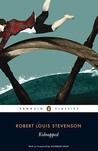 I enjoyed the beginning of Kidnapped, but I have to confess that I thought it dragged in the middle and the ending was a little too neat. I think this is due, in part, to the fact that I have never really caught the sea-story bug. Kidnapped is not solely a sea tale, but a good part of the action takes place on the ship on which the main character, David Balfour, has been taken captive. Stevenson uses much of the last third of the novel to put the manners of the inhabitants of the Scottish Highland on display for the reader. The picture is not flattering. In fact, there are some interesting similarities between Stevenson's descriptions of the Highlanders, and many of the stereotyping descriptions that exist in travel accounts of the American South in the mid-19th century.
Subscribe to:
Posts (Atom)